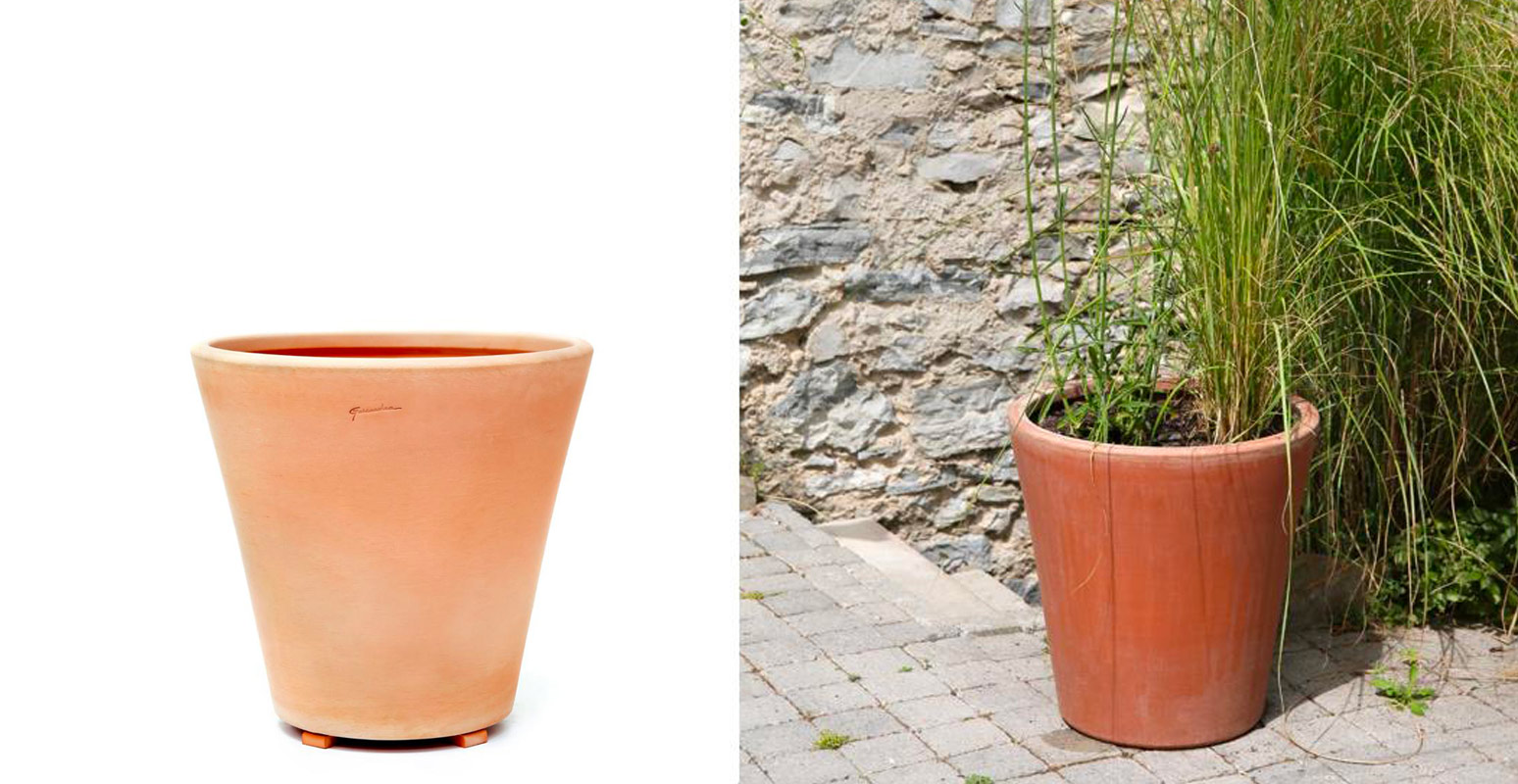

Terracotta is a porous material that breathes, lives, and reacts to its environment.
When you plant and water the plant afterward, the terracotta will absorb moisture unevenly through capillary action. There will be wet and dry areas, resulting in an irregular patina.
Therefore, it is important to thoroughly water the terracotta, both indoors and outdoors, before your first planting so that it absorbs moisture evenly. Repeat this process as many times as necessary until the patina becomes uniform.
It is possible that whitish marks may appear. These are salts in the soil being released for two reasons:
- hard water
- certain potting mixes cause a reaction in the terracotta.
To effectively reduce these white marks, we recommend spraying pure white vinegar or demineralized water around the area.
Repeat this process as many times as necessary.
Glazed pottery can be left outdoors, but it must be protected from frost.
Ideally, it should be kept indoors, and if necessary, protected by wrapping it in a winter fleece, making sure to protect the base.
When glazed pottery is left outdoors, the glaze will change, becoming slightly matte, and the salts in the terracotta will become more visible. This is a completely natural phenomenon, which you can minimize by spraying it with pure white vinegar and wiping it with a soft, dry cloth.
If you notice a chip or crack in the glaze, you can apply nail polish.